Malaysia Consumer Day 2013 (HPM 2013)

Malaysia Consumer Day 2013 is just around the corner! Let’s celebrate it by participating in 11 competitions held in the national level.

SWITCH!: National Energy Efficiency Awareness Campaign

SWITCH! is an effort by Non-Government Organisation (NGO) with the support from government and industries to increase the awareness on importance of ‘efficiency’ in the usage of energy and to play our roles and responsibility together with the government.

Do You as Consumer Aware Enough?

Learn more about consumer and consumerism by clicking on the picture.

Danger of Counterfeit and Fake Products

Dou you know counterfeit is really a serious problem to the world? Find out more about counterfeit by clicking on this picture.

Federation of Malaysian Consumers Associations (FOMCA)

FOMCA is a national non-govermental organization, which is the umbrella body of registered consumer associations in Malaysia. Find out more at their website.

Showing posts with label fake. Show all posts

Sunday, September 1, 2013

These Fancy Food Are Fraud!


Taken from Frugal Dad, he advices to not believe everything you eat.

Good frugal sense will tell you to approach spendy purchases with thoughtful hesitation, but, in this case, that seems easier said than done. The fact of the matter is, unless a product is truly transparent about its contents (not especially easy to determine), you could be wasting your money on overpriced cons.

Here you go, the infographic on these fake fancy food:

Tuesday, July 16, 2013

Concerns About Counterfeit Foods


A new report suggests that you might not be getting what you're paying for.

Watch this video that has been aired by ABC News on January 2013.

Source

Monday, July 15, 2013

Seizures of Counterfeit Foods in Yemen

Since the beginning of the year 2013, more than 57 tons of expired and counterfeit food products, cosmetics and medicines have been destroyed, said Khalid Al-Khwlani, the director of the Industry and Trade office in Sana’a to Yemen Times. There have been 581 documented violations; 522 have been referred for prosecution, he said. 

Eight ice-cream factors in the Dar Salm area have been closed for not meeting safety standards.

“We have established sub-committees in each district to periodically inspect shops and markets until the end of Ramadan,” said Al-Khwlani.

With a weak economy, people are increasingly turning to street vendors and markets for cheaper goods. The influx of people is resulting in more demand for goods, leading to more expired and counterfeit products, said the director of the Consumer Protection Authority, Ali Abdulaziz Al-Haj.

The Capital Secretariat confiscated nearly 50,000 packs of counterfeit chewing gum in Al-Sonaina shopping center in Sana’a. The owner of the shopping center was fined YR 400,000, about $1900.

Counterfeit goods aren’t limited to developing nations such as Yemen. The New York Times recently published an article about the phenomenon: Counterfeit Food More Widespread Than Suspected.

“Around the world, food fraud is an epidemic — in every single country where food is produced or grown, food fraud is occurring,” said Mitchell Weinberg to The New York Times. “Just about every single ingredient that has even a moderate economic value is potentially vulnerable to fraud.”

on 8 July 2013 in Yemen Times

10 Counterfeit Food Products Usually Consumed

Most perspicacious shoppers might guess that a pile of supposed Louis Vuitton handbags being hawked by a shady sidewalk vendor for $20 a pop are probably not authentic. But how about a lovely-looking bottle of extra-virgin olive oil on the shelf of the supermarket? Even the most shrewd of shoppers might not suspect that behind the label lurk 12 ounces of, say, humdrum corn oil. Welcome to the world of food fraud.

While a knockoff purse may pose little more harm than embarrassment upon its discovery, phony food can be a cause for concern. It can lead food allergy sufferers dangerously astray. As well, some items being used aren’t meant for human consumption, while others contain toxic components such as lead or melamine. While the list of foods on the database is extensive, here are some of the most commonly-consumed ones to be on the lookout for.

1. Orange juice

What could be complicated about orange juice? It is made from oranges, juiced — except when it’s not. That some juice makers feel compelled to regularly pump up their product with non-orange ingredients seems farfetched, but they do it. And in fact, orange juice is one of the most popular items to have suspect ingredients sneaked into the mix. The FFD is chock full of faux orange juices, one of the most shocking reveals a mixture of beet sugar, corn sugar, monosodium glutamate, ascorbic acid, potassium sulfate, orange pulp wash, grapefruit solids, and a byproduct from a water distillation system.

2. Honey

Honey is one of the most commonly mislabeled foods, representing 7 percent of food fraud cases. Last year, Food Safety News tested honey and found that 75 percent of store-bought honey didn’t contain pollen. People are still buying a product made from bees, but with no pollen food regulators are unable to identify the honey’s source. Consequent testing found that a third of all phony honey was imported from Asia and was contaminated with lead and antibiotics.

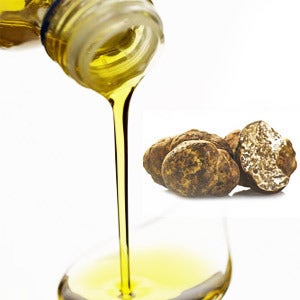
3. Truffle oil

This one comes as a shock to any self-respecting foodie upon its discovery. The fancy truffle oil that home chefs and beloved restaurants drizzle across pizza, pasta, and salads … isn’t flavored with real truffles. No, most commercial truffle oils are created by mixing olive oil with a synthetic petroleum-based flavoring agent, commonly 2,4-dithiapentane. Real truffle oil may be hard to find, but check the label for truffle “aroma” or “essence” to spot the imposter oils.

4. Blueberries

Berries, and blueberries in particular, have become a superfood darling and consequently, commonly faked – there’s a pretty lengthy list of retail food items that contain words or photos suggesting that real blueberries were used in the products, when in fact, they weren’t.

The nonprofit Consumer Wellness Center reported that many "blueberries" in popular products they found were nothing more than glops of sugar, corn syrup, starch, hydrogenated oil, artificial flavors and artificial food dye blue No. 2 and red No. 40.

5. Milk

Milk is one of the most commonly adulterated food items out there. A look at the FFD turns up pages of search results for milk, with a nightmarish list of adulterants. For starters: Melamine, non-authentic animal sources, formaldehyde, urea, hydrogen peroxide, machine oil, detergent, caustic soda, starch, non-potable water, cow tallow and pork lard.

6. Fish

Between sustainability issues and mercury levels, many of us are obsessively diligent about the fish we buy. So it’s depressing and distressing to discover that a study by Oceana from 2010 to 2012 found that 33 percent of the 1,215 samples they analyzed nationwide were mislabeled according to FDA guidelines. The samples were collected from 674 retail outlets in 21 states.

Samples labeled as snapper and tuna had the highest mislabeling rates (87 and 59 percent); only seven of the 120 samples of red snapper purchased nationwide were actually red snapper, the other 113 samples were another fish.

At the same time, farmed fish gets sold as wild catch and scallops are sometimes stamped-out whitefish. And buyer beware: A Consumer Reports study included a "grouper" sample that was really tilefish, a fish that contains frighteningly high levels of mercury.

7. Saffron

Few spices are as exotic or expensive as saffron, and consequently, few spices are knocked off as frequently. Commonly standing in for the costly crimson threads, according to the FFD, are creative adulterants such as marigold and calendula flowers, turmeric, corn silk, poppy petals, died onions, gypsum, chalk, starch, borax and glycerine, tartrazine, barium sulfate, sandalwood dye, colored grass, and red-dyed silk fiber.

8. Olive oil

Researchers have found that olive oil is the food most vulnerable to food fraud. In most cases consumers are getting a lesser quality than what is labeled – regular olive oil instead of extra virgin, or a cheaper, non-Italian variety being sold as Italian. But olive oil is also frequently diluted with imposter oils such as hazelnut oil, corn oil, sunflower oil, peanut oil, vegetable oil, soybean oil, palm oil and walnut oil. One sample even contained lard.

In rare instances, varieties of non-food-grade oil may be added in. In one notorious case, more than 600 Spaniards died in 1981 after eating a non-food-grade, industrial rapeseed oil that was sold as olive oil.

9. Pomegranate juice

Pomegranate juice is another food category undone by its own popularity. Ever since pomegranate juice hit the market, it has been lauded for its high antioxidant content, for which consumers are willing to pay a premium. So it’s with no little amount of frustration to find that “pomegranate” juice is often diluted with grape or pear juice, sugar, and high-fructose corn syrup. There have also been reports of completely "synthetic pomegranate juice" that didn't contain any traces of the real juice at all.

10. Coffee

If you buy whole beans and grind them at home, there’s less of a chance that your morning joe has been "enhanced" with the confounding oddities that find their way into ground and instant coffee courtesy of sketchy coffee producers. The following have been found in these forms of coffee: Twigs, coffee husks, roasted corn, roasted barley, roasted soybeans, chicory powder, rye flour, potato flour, burned sugar, caramel, figs, roasted date seeds, glucose, maltodextrins, starch and roasted ground parchment.


The moral of the story? Don't be scared by all of this, but be aware. Buy whole foods when you can. Shop at trusted co-ops and farmers markets when possible. Know that well-known names and bigger brands should be somehwat reliable, since they have a lot to lose if they're busted for mislabeling. And look out for deals that seem to good to be true; that super cheap saffron could well be nothing more than died daisy petals.

Counterfeit Foods: Are You Eating the Real Thing?


Think counterfeiting only extends to that knock-off name-brand purse or those slightly irregular DVDs you bought on the street? Think again. Everything is fair game to counterfeiters these days, from music to computer equipment to car parts.

But perhaps most frightening: The food you eat and the beverages you drink might not be the real thing.

While all counterfeiting is problematic, counterfeit food and beverages are especially tricky. The inherent health and safety risks are higher than those associated with, say, a knockoff pair of sunglasses, and they're also harder to detect once they've made their way onto store shelves. And unlike a fake purse whose handle falls off after you buy it, fake foods can hurt more than your wallet.

A Fish by Any Other Name

But beyond mere mislabeling is a more insidious type of food fraud: creating inferior products meant to pass as brand-name goods.

With advances in technology, a localized market and the constant push for value pricing, it's not always easy to tell what's real and what's fake.
Charges of mislabeling items to increase the sales prices aren't new. Only last year, large retailers were targeted in a lawsuit that claimed the products they were selling as organic weren't. Tamara Ward of the Food and Drug Administration says that counterfeit food cases can occur when consumers can't easily tell one item from another (as is often the case with certain varieties of fish), or are unable to distinguish by taste the differences among types of certain foods (such as extra virgin olive oil or raw honey).

Looks Can Be Very Deceiving

According to the Organization for Economic Cooperation and Development, the most successful food fraud occurs when the inferior item is not easily distinguishable from the real deal.

With advances in technology, it's becoming markedly more difficult to determine a counterfeit label from a real one, even in the face of anti-counterfeit security devices like holograms or tax labels. Well-designed packaging (even creating fake "brands") also helps these goods gain traction, enabling them to blend well on store shelves because they don't stand out next to their legitimate peers.

Counterfeiters will make most of their upfront investment in label-making equipment, and less investment in the inferior ingredients going into the food items. Simply put, the more they spend on the outside, the less they'll spend on the inside.

"In most cases, food fraud, or 'economically motivated adulteration,' is a pocketbook issue," Ward says, "but when ingredients are illegally substituted for what is on the label, consumers may be affected by unsuspected allergens or, in the worst case scenario, by toxic contaminants such as melamine."

So scan your shopping cart with skepticism. While it may be nearly impossible to tell a fake from the real thing, the same rule of avoiding counterfeit purses applies: Use common sense, don't buy an item with a label that has spelling errors or misprinted labels, and be wary of prices that seem too low.

Sunday, July 7, 2013

How to Identify a Counterfeit Medicine


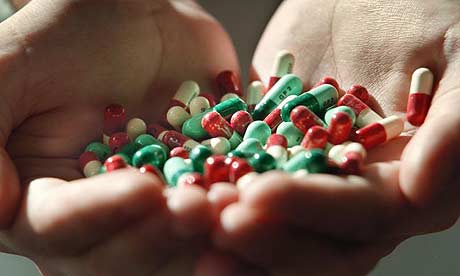
Today, more people than ever put their health in danger by purchasing counterfeit medicines. Up to 15% of all drugs sold worldwide are fake, and in some parts of Africa and Asia the figure exceeds 50%.

Consumers should be aware about the medicine they take, either real or fake. These are several ways to recognize counterfeit medicine; as stated by Bupa International:
  • Spot the difference. Is the lettering on the packaging hazy and printed flat (rather than raised), or is the expiry date missing?
  • Read carefully. Are the labelling and patient information in a language you understand? If there are misspelled words, contact the manufacturers – it can be a telltale sign.
  • Use your senses. Is the medicine the same size, shape, texture, colour and taste as your previous prescription?
  • Feel for consistency. When you handle the drug does it fall apart easily? If so, it could signal a fake.
  • Do a price check. Does the cost of the drug seem very cheap in comparison with your official provider? If it’s much lower, it could be a scam.

Friday, July 5, 2013

Are Fake Prescription Drugs Killing Us?


"What would have cost tens of thousands of dollars...can now be done for hundreds of dollars, so it's easier to fake stuff now," warns Roger Bate, resident scholar at the American Enterprise Institute (AEI) and the author of "Phake: The Deadly World of Falsified and Substandard Medicine."
Counterfeit, adulterated, or otherwise compromised prescription drugs are a major problem in Africa and a growing problem in the First World, argues Bate. In recent years, counterfeiters passed off hundreds of thousands of phony Lexapro pills around the globe and in 2008 at least 149 Americans died from fake Heparin, a blood-thinning drug. All told, says Bate, the number of deaths globally from ineffective drugs ranges from 100,000 to 1 million.

As drug production moves to China and other developing nations where oversight is tougher to maintain and more sales take place online where provenance can be tougher to ascertain, Bate says that the most viable solution is increased vigilance on the part of drug makers, providers, and patients alike. He looks forward to a fast-approaching world in which hand-held spectrometers verify pills on the spot and praises various online-pharmacy certification programs.
Referring to the classic 1949 film, "The Third Man," in which Orson Welles plays a drug counterfeiter whose watered-down penicillin in post-war Europe leads to the death of several children, Bate gives Hollywood credit for being well ahead of the curve on putting the spotlight on what he calls "the 2nd oldest profession."

Wednesday, July 3, 2013

The fight against counterfeit drugs


60 Minutes' nine-month investigation of counterfeit prescription drugs reveals how the dangerous and sometimes deadly fakes get into the nation's drug pipeline. Dr. Sanjay Gupta reports.


Tuesday, July 2, 2013

Control and Reporting Counterfeit Medicine In Malaysia

Control
The Ministry of Health has imposed the use of security label hologram (picture 1) to all medicinal products since September 2005. This is to prevent and control counterfeit products assessing the Malaysian market. Medicinal product with genuine MeditagTM hologram is considered genuine and medicinal product with fake hologram or without the MeditagTM hologram is considered counterfeit and unregistered. The authenticity of the MeditagTM hologram can be examined by the public in all community pharmacies in Malaysia using Decoder MeditagTM (picture 2). 

alt
Picture 1: Meditag Hologram

alt
Picture 2: Meditag Decoder

alt
Picture 3: Verifying the authenticity of the Meditag hologram in pharmacy

alt
Picture 4: Example of counterfeit medicine (with & without Meditag Hologram)

Reporting
If a medicine is suspected to be illegal or counterfeited, publics are advised to stop taking and seek medical advice should they fell unwell. They can report the incident to their pharmacist or doctor who will then inform the Ministry of Health accordingly. Alternatively they may report directly to the:

Pharmaceutical Services Division,
Ministry of Health, Malaysia,
Lot 36, Jalan Universiti,
46350 Petaling Jaya.
Tel: 03 7841 3200
Fax: 03 7968 2251 or

Public can visit the Pharmaceutical Services Division official web sites, www.pharmacy.gov.my for further information.

Source: MyHealth Ministry of Health Malaysia

Monday, July 1, 2013

What Is Counterfeit Medicines?


Introduction
Counterfeit medicines are found everywhere in the world ranging from random mixtures of harmful toxic substances to inactive and ineffective preparations. Some contain a declared, active ingredient and look so similar to the genuine product that they deceive health professionals as well as patients. But in every case, the source of a counterfeit medicine is unknown and its content unreliable. Counterfeit medicines are illegal in Malaysia. They can result in treatment failure or even death. Eliminating them is a considerable public health challenge.

Definition
The World Health Organization (WHO) defines counterfeits medicines as:
"medicines that are deliberately and fraudulently mislabelled with respect to identity and/or source. Both branded and generic products are subject to counterfeiting. Counterfeit medicines may include products with the correct ingredients or with the wrong ingredients, without active ingredients, with insufficient or too much active ingredient, or with fake packaging".

As for Malaysia, there is no specific definitions on counterfeits medicines, however the legislation for counterfeit products are well covered under The Trade Act. According to The Sales and Drug Act 1952: Regulation 7(1)(a), 7(1A)(a-g) of the Control of Drugs and Cosmetic Regulation (CDCR) states that all medicinal products must be registered with National Pharmaceutical Control Bureau (NPCB) Ministry of Health before being marketed. All registered medicinal products will be given a unique registration numbers.

Products with the following criteria are considered unregistered medicinal products which include the counterfeit medicinal products:-

(i) if they bear
  • No registration number
  • False registration number
  • Registration number belonging to other products
  • Registration number which has been cancelled
  • No safety label hologram Meditag TM
  • False hologram Meditag TM
  • Ingredient which differ from the original formula during registration
  • A mixture of 2 registered products
  • Information on the packaging which differ from the approved version
(ii) if they contain Adulterants

Thursday, June 27, 2013

Guidelines on Handling Counterfeit Banknotes by Commercial Banks


These are the guidelines on handling counterfeit banknotes by commercial banks, as provided by Central Bank of Malaysia (BNM) :

  1. Do not stamp “Disyaki Palsu”, write on, cut, re-circulate or alter the physical condition of the suspected counterfeit banknotes.
  2. Record full details of the sender’s name, address and I/C number, denomination, quantity of counterfeit banknotes and other related information in a record on the detection of suspected counterfeit banknotes.
     
  3. Hand-over a copy of (2) above to sender as proof of the bank’s receipt of the suspected counterfeit banknotes.
     
  4. Photocopy sender’s I/C and the suspected counterfeit banknotes.
     
  5. Lodge a police report at the nearest police station promptly and surrender the suspected counterfeit banknotes, copy of sender’s I/C and other related documents to them.

Checking a Fake Banknote

You might had visited the post on Detecting a Counterfeit Banknote but the article seems a lot of words and may irritate some of word-o-phobia (really?).

So we brought to you the video version which is more interactive and attractive, produced by lunaticg blog. The money used here is Malaysia Ringgit (MYR) 100.
Here you go:


Wednesday, June 26, 2013

How to Differentiate or Identify Counterfeit Notes using Banknote Detector

How to spot fake money?  How to check and confirm forgery notes?
Here are some useful tips to identify counterfeit RM50 notes; brought to you by Nibo Corporation Sdn Bhd.
*RM/MYR stand for Ringgit Malaysia


Overall paper reflection of UV light
 ( means real banknote, X means fake banknote)

Security vertical strip does not differentiate the real and fake banknotes
Deer head reflection (real banknote)
Deer head reflection (fake banknote)

Serial number reflection (fake banknote)
Serial number reflection (real banknote)

Tuesday, June 25, 2013

What Do You Do If You Receive a Counterfeit Banknote?


After you able to detect any counterfeit and fake banknote, you must be wondering; what should I do now?

Some advices, do notify the police immediately if you have received counterfeit banknotes. Using or returning counterfeit banknotes is just as illegal as manufacturing it. Counterfeit banknotes are not eligible for replacement!

Follow these steps (as provided by Central Bank of Malaysia or BNM):
  • Delay the person (passer) who gives you the counterfeit banknotes if possible and observe the passer's description, as well as that of his/her companion if any, and the license numbers of any vehicles used by them
     
  • Do not write on, cut or re-circulate the counterfeit currency
     
  • Handle the currency as little as possible (e.g. you can put it in an envelope or plastic cover). Record on a separate sheet of paper all the details about how you got the currency, who gave it to you, where and when you got it
     
  • Take the counterfeit currency to the nearest police station and surrender the counterfeit currency to them after lodging a police report

Monday, June 24, 2013

Online Scam: Couple, Two Men Nabbed for Circulating Counterfeit Notes


A couple and two men have been arrested by police in separate raids in Petaling Jaya for possessing and distributing counterfeit notes.

Police said the suspects, believed to have been active since October last year, were nabbed on June 5th and 11th after they were detected using the fake money to cheat individuals selling items online.

Authorities also seized an undiclosed amount of 100 ringgit counterfeit bills, printing equipment and several handphones.

A total of 13 reports have been lodged over the matter, involving losses amounting to 21 thousand ringgit.

All those detained, aged 27 and 28, were remanded until June 15 to facilitate investigations.

Source

Detecting a Counterfeit Banknote

Counterfeit banknotes are reproduction of the real banknotes using materials of low quality but appear similar to the genuine with intent to deceive member of the public.

Counterfeit banknotes have no value but it is possible that they may be used and may escape detection for some time. Thus, protect yourself and always check your banknotes when you receive them. Here are some tips from Central Bank of Malaysia (BNM).

Detecting a Counterfeit Banknote

All counterfeits of modern banknotes can be recognized without too much difficulty. The differences can be seen upon closer examination by applying the "FEEL , LOOK, TILT and CHECK" Principle.

1. Counterfeit Detection: Feel
Security Features Genuine Counterfeit
Feel the quality of paper The genuine banknote is usually printed on very high quality paper and manufactured from cotton. It has a unique feel, crisp sound and slightly rough in the heavily printed areas. The paper used for making the counterfeit notes appears to be poor quality,most common commercial type of paper.
Feel the Intaglio Printing The intaglio print is a raised printing effect produced by applying layers of tactile inks on various parts of the front and reverse sides of the notes The counterfeit banknote does not have feeling the raised printing.

2. Counterfeit Detection: Look
Security Features Genuine Counterfeit
Look at the banknote and hold it up to the light The genuine banknote carry a watermark portrait, security thread and perfect see through features . A watermark portrait of Yang DiPertuan Agong has three dimensional effect and appears soft and shady without sharp outlines portrait. At the base of watermark a denomination number is clearly visible.
The security thread will always looked embedded in the paper. The hibiscus flower on the obverse will register perfectly with the same flower on the reverse of the banknote.
The watermark in the counterfeit is not visible. If any, it can be appears like a drawing.

The security thread is simulated and rather blurs, and can be easily scrapped off.
The see through features does not perfectly registered with the pattern on the reverse side of the banknote.
Look under magnifying glass You can see micro lettering on observe and reverse sides of all banknotes. The lettering on a genuine banknote should be sharp and not blurred. The micro lettering of the words 'BANKNEGARA MALAYSIA', 'BNM' and banknotes denomination i.e. RM1, RM5, RM10, RM50 and RM100 on the banknote are not present, only dots are printed to simulate this features.
Look ultra-violet light Invisible fluorescent elements representing various elements of the background on the obverse and reverse will fluoresce in different colours. Various elements are captured under UV light such as invisible fibres and phosphorescence square. Under UV light the invisible fibres and phosphorescence square are completely missing in the counterfeit note. The paper of the counterfeit is UV bright, meaning that it glows more than genuine banknote paper.


3. Counterfeit Detection: Tilt
Tilt the banknote
LEAD feature (incorporated in RM10, RM50 and RM100)
You can see the iridescent stripe shines under a bright light and showing the banknote denomination and the name of BNM when the view angle is shifted.

Lead feature is very difficult to counterfeit. Normally the shines of the LEAD cannot be seen. Some counterfeiters will attempt to simulate it by using a plain shiny foil.

PEAK feature
When changing the angle of view by shifting the banknote, a hidden image of denomination number i.e. 50 will be revealed in the centre of the PEAK square.
There is no latent image of denomination in the PEAK feature or some simulation of image has been attempted.

Security Features
Various security features have been incorporated into the Malaysia Ringgit banknote. It is important for you to be aware of some of these security features and be able to distinguish between genuine and counterfeit notes which are completely worthless.

Level
Examination
Security Features
Level I : Public Human Sense
  • Watermark Portrait
  • Security Thread
  • LEAD Feature
  • PEAK Feature
  • Perfect See Through
  • Intaglio Print
Level II : Cash Handler Human Sense & Equipments
  • All the first level features
  • Security Fiber
  • Fluorescent Elements
  • Micro Lettering
  • Fluorescent Square

Friday, June 21, 2013

Counterfeit HP Printing Supplies Worth Almost $200,000 Seized in Malaysia


May 8, 2013 - MALAYSIAN law enforcement officers seized 80 counterfeit ink cartridges and more than 2,000 counterfeit toner cartridges worth more than RM540,000 (US$182,250) in Kuala Lumpur recently, Hewlett-Packard said in a statement.

The ‘entity’ found with the fake products was involved in the sale and distribution of counterfeit HP materials to commercial businesses in Kuala Lumpur, the company said.

There were no arrests made but a follow-on investigation to identify the entity’s downstream customers, upstream suppliers and any related facilities is underway, it added.

A counterfeit product is a product which has been made to look identical to or substantially indistinguishable from the genuine or original product, usually for the purpose of deceiving customers.

The counterfeiting of printing supplies usually involves the illegal printing of HP-branded boxes, labels and security seals. Often refilled cartridges containing inferior inks and toners are used and inserted into this packaging that closely resembles genuine HP packaging. The counterfeit cartridges are ultimately purchased by customers who believe them to be genuine.
 
“HP appreciates the commitment and support of the Malaysian authorities in protecting consumers and businesses against the illegal actions of counterfeiters, who deceive customers into thinking they are buying genuine goods,” said Jimmy Kwok, anti-counterfeit manager, Printing and Personal Systems, HP Asia Pacific and Japan.

“Counterfeit print cartridges run several risks, ranging from substandard print quality to printer downtime due to damage by inferior counterfeit supplies,” he claimed.

HP said its anti-counterfeiting programme in the Asia Pacific region has resulted in law enforcement agencies successfully confiscating more than 25 million units of counterfeit cartridges and components in the last four years.

On a global level, HP maintains an aggressive approach to anti-counterfeiting and has conducted more than 4,600 investigations in 88 countries over the last four years. This has resulted in the seizure of more than 36 million units of counterfeit printing cartridges and components worldwide.

All HP cartridge packaging in the Asia Pacific region displays a security seal with colour-shifting technology that helps customers easily identify genuine HP supplies. To visually verify that the label is valid, customers should tilt the box front to back to see “OK” and “ ” move in opposite directions. When the box is titled right to left, they should see OK” and “ ” move in the same direction.

HP has also introduced security seals with QR codes, allowing for Mobile Authentication with the QR code reader on customers’ mobile device.

Customers can learn more about how to use this security seal as well as other best practices to avoid purchasing counterfeit cartridges at www.hp.com/apac/nofakes.

Source : Digital News Asia
Read more : The Recycler

Thursday, June 20, 2013

Counterfeit Production Facility

Trademark counterfeiting is a very serious problem with many consequences that most people don't understand.

Take an inside look at a counterfeit operation and see first a counterfeit factory in action.

Avoid Counterfeit Check Scams


Unwitting consumers are falling for a new twist on the old “advance fee scam.” In this variation, a consumer receives what looks like a legitimate check in the mail, either as “foreign lottery proceeds,” “prize money,” or even payment for goods via classifieds (which includes Craigslist and eBay). 

The scammer requests that you send back a portion to pay for fees or handling charges, or says they “overpaid” and need you to pay back the difference. The check clears when deposited in the bank. A few days later, the check bounces and the thief has got whatever the rube sent them.

The US Federal Trade Commission advises:
  • Don’t wire money to strangers.
  • Throw away offers that ask you to send back money for your “free” gift.
  • Only accept checks from people you trust.
— BEN POPKEN

Fake Britain: Counterfeit Goods


From his 'Fake House' stuffed with counterfeit goods, presenter Dominic Littlewood reveals the extent of fake goods in the UK.

We investigate the tragic tale of seven-year-old Connor O'Keefe who was electrocuted and died after using a fake power charger for his electronic game. Fake electricals are produced in the Far East but are potentially lethal. Fake Britain examines fake fuse boxes which are tested with alarming results.

There's a look at the fake mini motorcycles that endangered the lives of the children they were bought for, and the case of the company which bought non-organic food, rebranded it as organic and made a small fortune.

Customs and Excise officers search a high street shop and find thousands of fake cigarettes, before uncovering an audacious plan to smuggle fake cigarettes from China into the country hidden in huge fans, while Trading Standards and Customs officers shut down a fake vodka distillery and find hundreds of bottles of fake vodka on sale. We even see how good old British cod and chips is being faked in fish shops by using a much cheaper fish from Vietnam.

Twitter Delicious Facebook Digg Stumbleupon Favorites More